This professional learning course is designed for all educators who will be implementing the Reading Horizons Discovery program and aligns with my Innovation Plan. The course will encompass professional learning components throughout the entire first year of program implementation. The course was designed based on Fink’s (2003) taxonomy of significant learning. The 3-column table outlines how learning outcomes align with the learning activities and assessments that are used throughout the course. By the end of the course educators should have the resources and knowledge they need, as well as feel confident, to implement the Reading Horizons Discovery program in their classroom for foundational literacy instruction.
BHAG – Overarching Course Goal
To develop educators who embrace the role of learner and continually strive to reflect and adjust their foundational literacy teaching practices to ensure optimal student outcomes through implementing the Reading Horizons Discovery program.
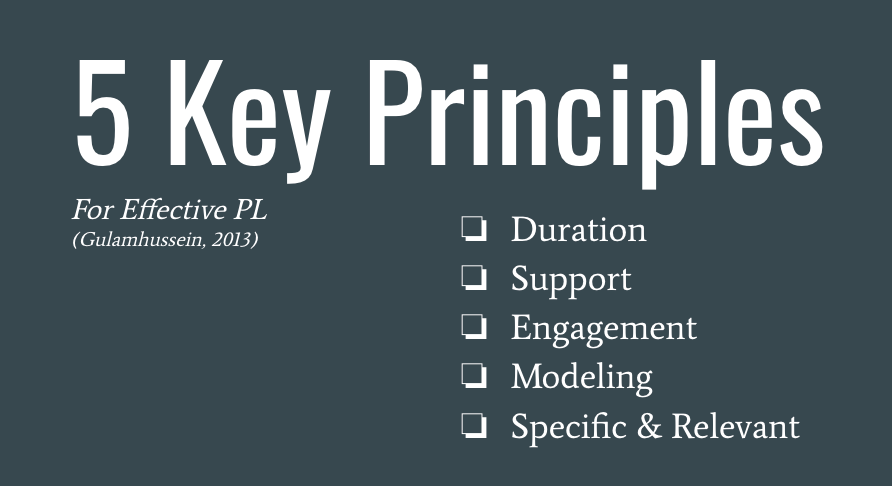
This professional learning course will align with the 5 key principles of effective professional learning (Gulamhussein, 2013).
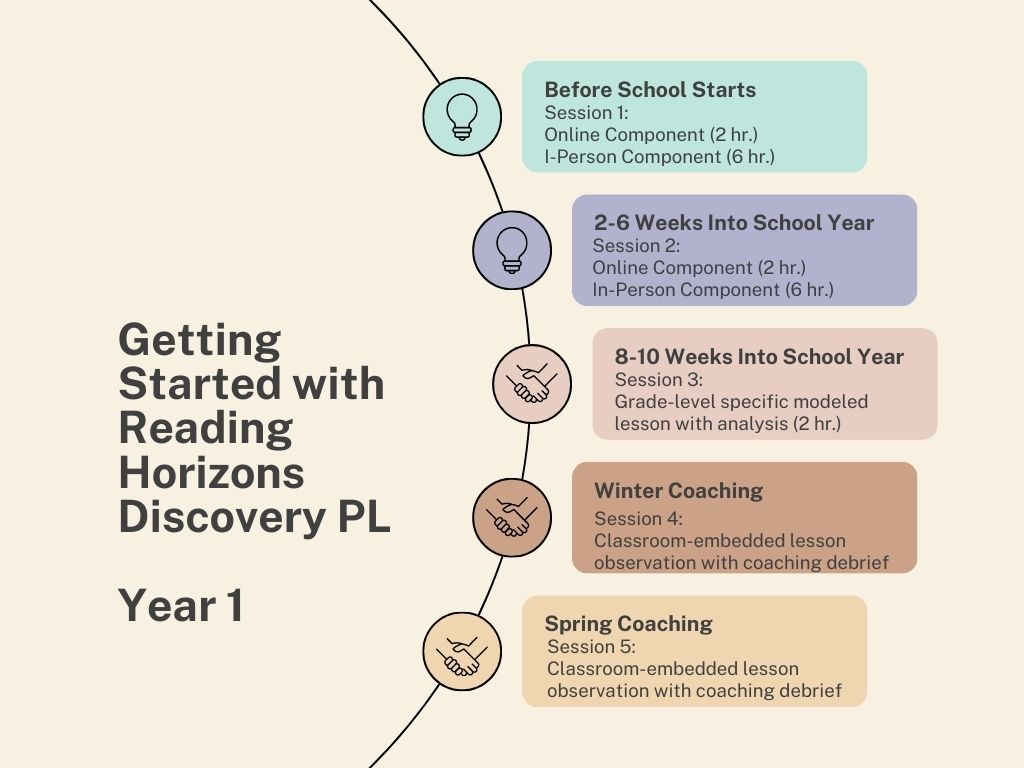
DURATION: Professional learning needs to allow plenty of time for teachers to learn a new strategy and figure out how to implement that strategy in the classroom. A blended learning approach to PL allows for significant learning and practice. In addition to 4 hours of online content and 12 hours of face-to-face active learning, this PL plan also incorporates an ongoing, gradual release method. Teachers will participate in two full days of PL, observe a model lesson in a grade-level specific classroom at their campus, then participate in two lesson observations with coaching feedback from an expert spaced throughout the year.
SUPPORT: Teachers need support during the actual implementation of a new teaching strategy. A one-and-done workshop will not cut it to actually see teacher practices change. This PL plan addresses the challenge of changing classroom practice by extending PL into the teachers’ campus and individual classrooms through model lessons and job-embedded coaching with supportive feedback. This ongoing support has been instrumental in improving implementation of the program and impacting student outcomes.
ENGAGEMENT: This PL plan ensures that teachers are engaging with the content by using active learning approaches. The online portion of the course includes video modules, practice activities, implementation questions, assessments, and additional resources. The face-to-face portion of the course utilizes active learning strategies such as think-pair-share activities, self-reflection, games, modeling by an expert, peer-to-peer practice, and watching classroom implementation examples.
MODELING: Teachers have the opportunity to experience new teaching strategies modeled several times throughout the PL. They will experience modeling in the online portion, then again during face-to-face time. During the face-to-face time, teachers will be fully involved in the modeling by acting as the student while the facilitator models teaching strategies and best practices. The next step is observing a facilitator model a full lesson in a grade-level classroom with students. The facilitator may include additional modeling if appropriate during the classroom observation coaching.
SPECIFIC: This PL plan provides information that is specific to the content area of teaching reading to K-3 students using the Reading Horizons curriculum. It becomes even more specific as teachers move into the modeled lesson and job-embedded coaching components. These modules of the PL are conducted in a teacher’s classroom with the teacher’s actual students. This type of specificity allows for all learning to be completely relevant and immediately useful.
How will you foster collaboration?
Collaboration will be fostered throughout each portion of the PL in a variety of ways. Learners will participate in small-group and whole-group discussions during in-person PL events. Teachers will provide their peers with feedback and support during practice activities and share their ideas of how they will implement strategies and resources. They will be encouraged to collaborate as grade-level teams during the implementation phase as well. Learners will experience grade-level collaboration during modeled lessons and debrief discussions. We also encourage teacher collaboration on a broader scale by sharing our community involvement options, a facebook group called the Reading Horizons Teachers League, and The Science of Reading Collective for like-minded teachers across the country.
Who will lead what components?
The learners will lead their own learning during the online portion of the PL. They will have the opportunity to delve into additional provided resources if they choose. The facilitator will lead the in-person full-day events. However, the modeled lesson debrief discussion and job-embedded coaching discussions will be led by the teachers. This will be their time to get specific questions answered and receive support and feedforward on exactly what they need.
Who is your audience and what are their needs?
The audience for Getting Started with Reading Horizons Discovery PL events are current educators and administrators who are using the RHD curriculum in their school/district. The attendees of RH PL events are diverse and vary widely in their cultural, socio-economic, and personal backgrounds. Even the professional background, experience and prior knowledge of foundational literacy varies extensively within each school/district. One PL event may include paraprofessionals, administrators, experienced teachers, new teachers, reading or literacy coaches, instructional coaches and more. Despite the heterogeneous nature of attendees, in my experience, their learning goals and expectations are in alignment. When asked what they are hoping to get out of the PL event, most teachers respond with some variation of wanting to learn strategies to support struggling readers or they hope to improve their instructional practices to get all of their students reading on level. This common goal unites us within the learning environment.
Resources
- Login and account on www.rhaccelerate.com
- Laptop for online component and for in-person teaching practice
- In-person materials (packet/workbook)
- Curriculum materials (for coaching observations)
Course Outline
References
Fink, L. D. (2003). A self-directed guide to designing courses for significant learning.
Gulamhussein, A. (2013, Sept). Teaching the teachers. Effective professional development in an era of high stakes accountability. Retrieved from Center: http://www.centerforpubliceducation.org/system/files/2013-176_ProfessionalDevelopment.pdf
 Facilitation Innovation
One response to “Planning PL”
[…] PLanning PL […]
LikeLike