
Organizations are consistently looking to improve in various ways. They may want to grow the business, gain market share, expand product offerings, improve customer experience, or streamline company processes. One key feature of accomplishing any goal is change. If we continue doing what we have always done, we will get the same results we have always gotten. This is where the four disciplines of execution provide a clear process of moving towards wildly important goals while respecting that the day-to-day ‘whirlwind’ tasks must still be accomplished. I believe that installing a 4DX strategy can help my organization achieve what we are most passionate about–eradicating illiteracy.
“If you let the whirlwind overwhelm your commitments, you’ll never invest the energy needed to progress.”
McChesney et al., 2016, p. 184
The Influencer model and 4DX
The Influencer Strategy I created meshes well with the 4DX Strategy I will outline here. While both approaches aim to support organizations in achieving their goals, they focus on different domains. The Influencer Strategy focuses on the vital behaviors that lead to change and the holistic sources of influence that can bring about those vital behaviors (Grenny et al., 2013). While the 4DX Strategy focuses more heavily on the execution processes that will lead, step by step, to achieving wildly important goals (McChesney et al., 2016). I believe that utilizing both of these strategies in support of my innovation plan will ensure success in meeting current goals and setting up a culture that can consistently apply tested processes to future goals.
Installing 4DX
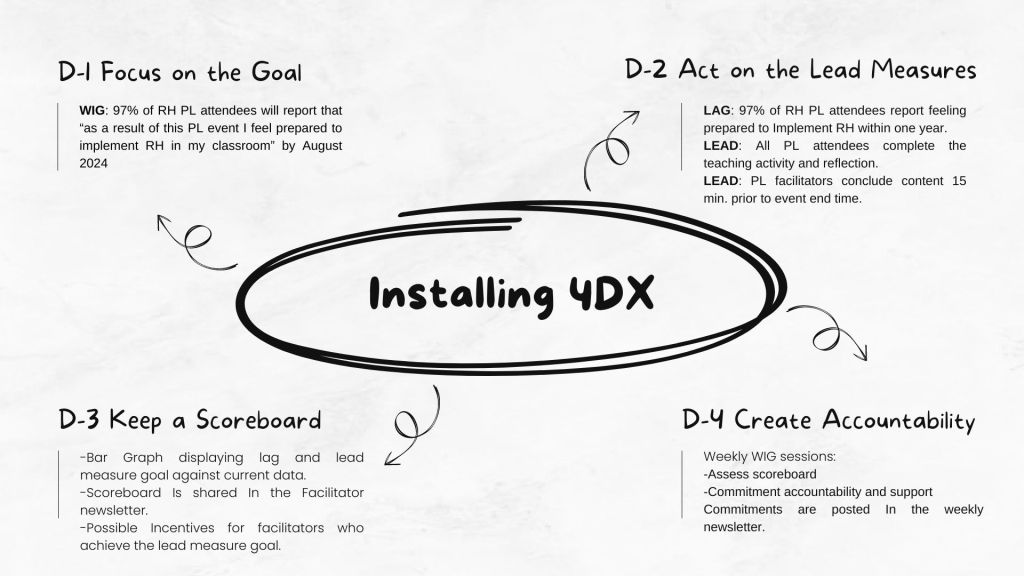
4 Disciplines
Discipline 1: Focus on the Wildly Important
The first discipline is to focus on the one goal, or WIG (Wildly Important Goal), that will make the biggest difference. This is a shift from the typically long list of goals an organization may have. McChesney et. al. (2016) argue that narrowing the focus to only one or two wildly important priorities increases the chances of achieving those priorities. If we try to accomplish too many goals at once they tend to get lost in the whirlwind. It is key that when determining the WIG there is as much involvement from leaders and teams across the organization as possible. “Without involvement, you cannot create the high levels of commitment that execution requires (McChesney et. al., 2016, p. 36).” For our team, we will focus on one WIG which is that 97% of RH PL attendees will report that “as a result of this PL event I feel prepared to implement RH in my classroom” by August 2024. During stage one of the stages of change, the PL team will discuss, perfect and agree upon this WIG.
Discipline 2: Act on the Lead Measures
In order to accomplish the WIG, we must determine what lag measures will measure the success of the goal itself, as well as the lead measures that will predict the movement of the lag measure. There are two important characteristics of lead measures. Lead measures must be both predictive of moving the lag measure and must be directly influenceable by the team. Another consideration is the ability to track the lead measures. For my strategy, we will focus on the lag measure of 97% of educators feeling prepared to implement RH in the classroom within one year of blended learning PL implementation. The lead measures we could use are ensuring all PL attendees complete the teaching practice activity and teacher reflection, and facilitators complete the live PL component 15 minutes before the scheduled end time to allow for questions, discussion, and resource sharing. During stage one of the stages of change, the PL team will discuss, adjust, and agree upon these lead measures.
Discipline 3: Keep a Compelling Scoreboard
The third discipline is to keep a simple, compelling scoreboard. This is crucial to success because “people play differently when they’re keeping score (McChesney et al., 2016, p. 12).” In order to keep team engagement high we have to be able to quickly and easily see where we want to be and if we are winning. I like the idea of using a simple bar graph scoreboard that shows the percentage of the lag measure against the goal, as well as the lead measure of the percentage of facilitators self-reporting event completion 15 minutes prior to event time against the goal. See the example below.
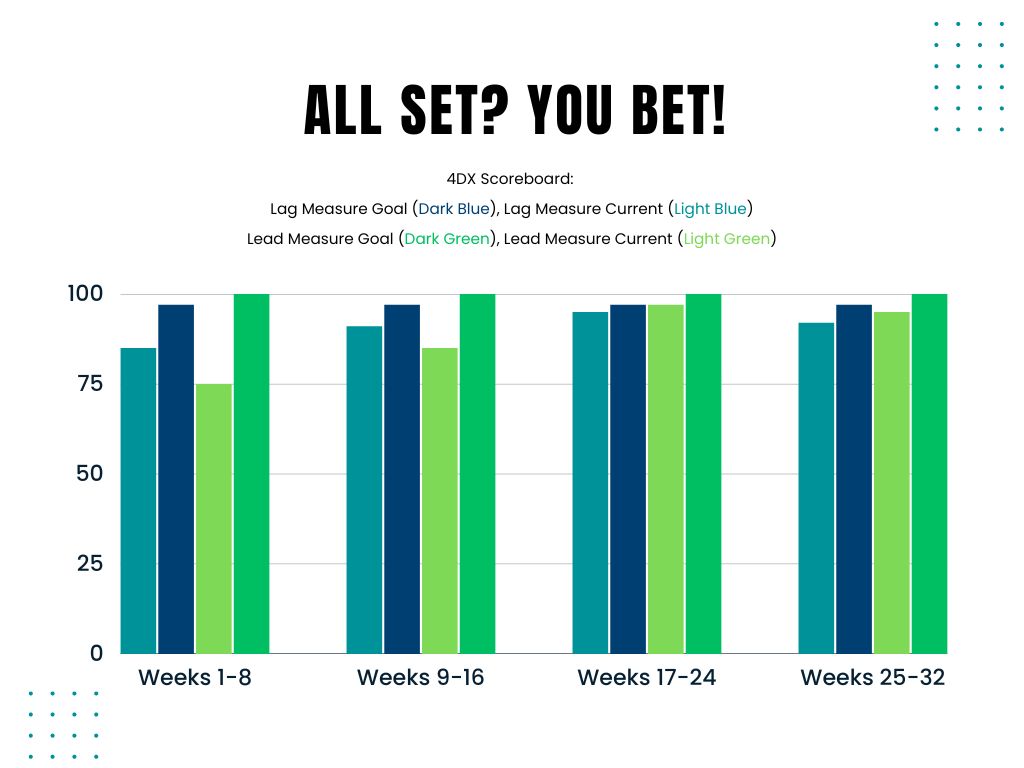
The scoreboard design and effectiveness for displaying relevant data will be discussed and agreed upon during stage one of the stages of change. This scoreboard will be shared with the team each week in the facilitator newsletter and utilized for accountability during weekly WIG sessions. I also think it would be great to have an incentive like a weekly drawing or newsletter shout-out for facilitators who achieve the lead measures to maximize engagement.
Discipline 4: Create a Cadence of Accountability
The final discipline of creating a cadence of accountability is the key to executing a change strategy. Without a consistent method of holding each other accountable the goal will get lost in the whirlwind. The challenge we face with establishing a cadence, or rhythm, of accountability, is the fact that the facilitator team is primarily made up of independent contractors. We cannot require them to attend meetings outside the scope of their contract work. My idea is to hold weekly WIG sessions that are a mere 15 minutes long. They cannot be required of facilitators, but they can be highly encouraged and incentivized. My vision is that the weekly WIG sessions be run by one of the lead facilitators and include reviewing the scoreboard, accounting for previous commitments, and making new commitments. Commitments can be submitted via Google form to the lead facilitators and included in the weekly newsletter. During the WIG session, facilitators will have the opportunity to share if they need support to accomplish their commitments and encourage each other. The lead facilitator will ensure that commitments are focused on moving the lead and lag measures.
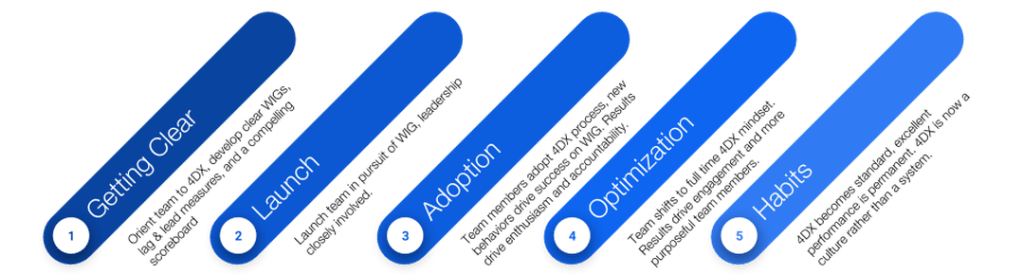
5 Stages of Change
Stage 1: Getting Clear
In this initial stage, it is important for the team to become oriented to the four disciplines and understand their role in the execution strategy. We will work together to identify our wildly important goal by looking at not only what is the most important thing to do, but what will make the biggest difference assuming everything else stays the same. During this stage, we will also identify lead measures that will contribute to moving the needle on our WIG. The team will collaborate to design an easy-to-read scoreboard. The team will also discuss and agree upon logistics to create a cadence of accountability. These actions lay the groundwork for rolling out our 4DX Strategy across the team.
Stage 2: Launch
This is when the fun begins! We plant the seeds of change by holding a launch meeting with the entire Facilitator team. This should be a fun and exciting moment where facilitators are shown an overview of the strategy and are able to clearly see their role in reaching the WIG. Key components of the launch include facilitating an understanding of 4DX, outlining the WIG, lag and lead measures, revealing the scoreboard, and communicating how the cadence of accountability will work. Even more important is to get feedback and buy-in from the team. The 4DX strategy will be positioned as flexible with room for the team to contribute their ideas and adjustments to be made. As a leader on this project, I will strive to build trust with the team by modeling accountability and being willing to hold crucial conversations that will lead to a stronger strategy.
Stage 3: Adoption
At this stage, the team is starting to see some movement in the lead measures and there is decreased resistance and increased enthusiasm for the 4DX Strategy because we can see progress toward success. The biggest challenge at this stage is establishing and maintaining the cadence of accountability in the midst of the whirlwind and the hubris of some early success. Keeping the scoreboard front and center will help keep everyone focused on the WIG.
Stage 4: Optimization
In Stage four we really see the 4DX mindset take hold. Team members have felt the satisfaction of playing to win! This influences them to be more purposeful in their work. They are thoughtful and committed to following through on attending WIG sessions and achieving their commitments. We are now optimizing the processes. It is crucial to not become complacent at this stage. Continue to celebrate wins and encourage team members to finish strong as we get closer to our WIG.
Stage 5: Habits
Once the processes of 4DX become habitual for the team, we can expect to reach our goals and see an elevation in the performance of the team across all areas. The goal of 4DX is not only to accomplish individual WIGS but also to create a culture of high engagement and execution. Now that the team has united in the 4DX process we know that they can be successful in taking on new WIGS that will move us closer to our overall organizational mission.
References:
Grenny, J., Patterson, K., Maxfield, D., McMillan, R., & Switzler, A. (2013). Influencer: The new science of leading change (2nd ed.). McGraw-Hill Education.
McChesney, C., Covey, S., & Huling, J. (2016). The 4 disciplines of execution: achieving your wildly important goals. Free Press.
Yamashita, J. (n.d.). 4 disciplines of execution. AdultEdTech. Retrieved April 22, 2023, from https://jerryyamashita.com/4-disciplines-of-execution.html
 Facilitation Innovation
One response to “Installing 4DX Strategy”
[…] INSTALLING 4DX […]
LikeLike