
MY WINDING PATH
My journey into the education field has been a winding one. When I was a teenager I wanted to be a physical therapist. My favorite subject was biology. I chose to earn a degree in Therapeutic Recreation and worked as a Certified Therapeutic Recreation Specialist for the first several years of my career. I loved working with people. I enjoyed developing treatment plans and making connections to the experiential and art therapies I conducted. But most of all I liked helping others.
“A career path is rarely a path at all. A more interesting life is usually a more crooked, winding path of missteps, luck, and vigorous work. It is almost always a clumsy balance between the things you try to make happen and the things that happen to you.” -Tom Freston
After a career break to have and raise my four children, I decided to make the leap into education. I got a job teaching English virtually to students in China. I quickly fell in love with my students and felt a passion for the work of teaching. I had several opportunities open to me within the company I taught for. I was invited to move into an in-person teacher training and coaching role. I discovered this role filled me up. When we weren’t able to reach enough teachers in person, I was part of the development of an online training and coaching pilot. That pilot grew to serve thousands of teachers all over the globe.
I continued to work in the Edtech field as I moved into an international student mentor position for a higher education institution. I connected with students in over twenty different countries. My idea of what education could look like and who could access it through technology, along with my worldview, expanded. I now work with a literacy curriculum company as a professional learning facilitator, curriculum coach, and education specialist. While the curriculum incorporates a software component and a blended learning approach for students, we do not apply the same digital learning tools to teacher professional learning. This is the impact I am looking to make within my organization.
MY CORE BELIEFS
One core belief that I hold about digital learning is that it should be part of a holistic learning approach that also incorporates instructor guidance, learner reflection, and the opportunity for learned skills to transfer to real-life authentic application. I believe that we are underutilizing digital learning tools within professional development. I hope to make an impact in my organization by implementing a blended learning approach in a professional learning setting. The framework is in place, but the utility and integration of technology is a work in progress. My innovation plan has the potential to increase the efficacy and value of professional learning for teachers.
Another core belief I hold is that we are all lifelong learners. No one is ever done learning. There is so much in this incredible universe to learn more about! Fostering a love of learning can be achieved by striving to be in a growth mindset and helping students to make real-world connections to their learning (Dweck, 2016). This allows students to identify their ‘why’ for learning, and encourages learners to embrace challenges and understand their own limitless potential for growth. I believe in using the knowledge I gain in my education to serve others and improve individual lives, communities, and beyond.
“Education is for improving the lives of others and for leaving your community and world better than what you found it.” -Marian Wright Edelman
MY PASSION
I am passionate about literacy. I believe that almost everyone has the ability to learn to read. I believe that each person has a right to effective reading instruction that honors the dignity of the learner regardless of age or circumstance. Equitable literacy instruction includes meeting every learner where they are and utilizing science-based instructional practices. In my experience, reading is a window to new worlds and experiences that result in expanding the reader’s worldview, increasing their empathy, and connecting them to a global community.
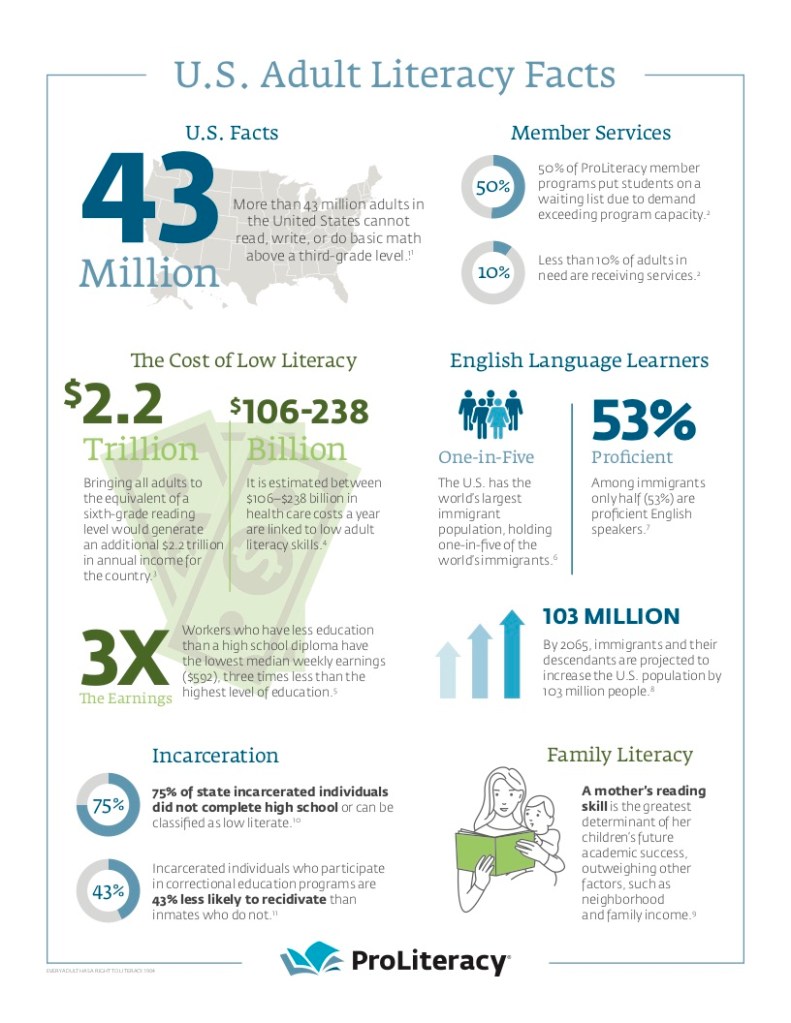
I believe literacy is literally opportunity. There are 43 million adults in the US who cannot read and write higher than a 3rd-grade level (Adult Literacy Facts). This translates to lower income, higher incarceration rates, higher healthcare costs, etc. “Every important social issue is impacted by low literacy (DataPoint, 2019).” Literacy opens doors to a better life.
How can we decrease the number of functionally illiterate adults in our country? We must start by equipping educators with the knowledge and tools they need to be effective instructors. I believe that the digital world is our world. We should utilize instructional technologies to facilitate differentiated learning through various blended learning models, quality diagnostic tools, and job-embedded professional learning. When educators have what they need to effectively teach reading in the elementary grades, then we will have significantly less triage to do in secondary education and in the adult population.
ISSUES & SOLUTIONS
I see so many beautiful things happening in classrooms around the country. I have the privilege of visiting many schools and districts in different states. I get to observe teachers and students working together in the classroom. Sometimes it’s a lovely waltz and sometimes it’s an awkward two-step, but the efforts are there. When I see teachers who are really struggling in the classroom I do what I can to help them make small adjustments to improve their instruction and their students’ learning. However, what I believe they really need is consistent differentiated support. Tailored professional learning and caring learning communities are part of the solution.
Educational equity is a huge problem. Recently, within the US, there has been a brighter light shining on the disparity among students of varying socioeconomic backgrounds, and globally there is a very clear divide. I witnessed this in my work as an international student mentor in higher education. I worked with students from over twenty different countries. Their educational backgrounds were scattered and inconsistent. Their access to, and ability to succeed in, higher education was lower than many individuals in the US. I was proud to be part of a support network for these higher-risk students. I think the model used for supporting these international students with mentors and tutors could translate well to disadvantaged students in the US. Unfortunately, the funding needed to level the playing field for all students is not something that our current partisan political climate seems to be capable of producing.
”Human flourishing is not a mechanical process; it’s an organic process.” -Sir Ken Robinson
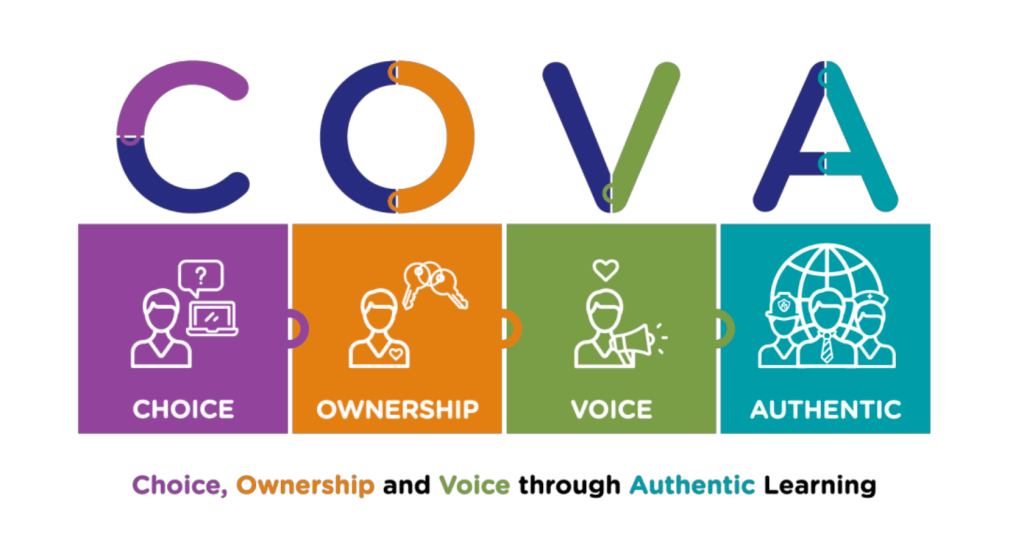
There is a vital need for our education system as a whole to revolutionize away from an industrial model to an agricultural model where we create conditions for learning to happen. We can leverage digital tools and strategies to enrich the learning environment and personalize learning for each student. This can happen by implementing the CSLE + COVA approach. Creating significant learning environments by giving students choice, ownership and voice through authentic learning opportunities provides fertile conditions for learning to take place (Harapnuik, et al., 2018).
One of the most imposing barriers to this educational revolution is the education system’s heavy reliance on standardized testing. Test scores directly affect school funding. This means that district, region and state education leaders are forced to focus on how to increase test scores. The problem here is that the lens is less on actual learning and more on the ability of students to regurgitate information. Teachers are also pigeonholed by this focus on standardized testing. They may not feel empowered to look at all of the digital options available to them if these digital learning tools do not directly lead to increased test scores. Teachers have a big job teaching regulated standards, but more importantly, teaching students how to succeed in our digital world in the future.
“If we teach today’s students as we taught yesterday’s, we rob them of tomorrow.” -John Dewey
MY IDEAL
I may be simplistic and optimistic in my hopes for an equitable, learner-centered education system, but that is just who I am. I am striving to invest wholly in my own self-directed learning. We have so much information at the tips of our fingers that it seems antiquated and unnecessarily laborious to not utilize digital tools to access it! I want to be part of the solution by implementing innovative digital learning practices in my own organizion, then encouraging those practices to become more widespread through my influence on schools and districts across the country. It is up to each one of us to fuel the educational revolution. I am here for the challenge.
“Education is what people do to you, and Learning is what you do to yourself.” -Joi Ito
References
Adult Literacy Facts. (n.d.). ProLiteracy. Retrieved November 20, 2022, from https://www.proliteracy.org/Adult-Literacy-Facts
Data Point: Adult Literacy in the United States. (2019, July). National Center for Education Statistics. Retrieved November 20, 2022, from https://nces.ed.gov/pubs2019/2019179.pdf
Dweck, C. S. (2016). Mindset: The New Psychology of Success. Ballantine Books.
Edelman, M. W. (1992). The Measure of Our Success: A Letter to My Children and Yours. Beacon Press.
Harapnuik, D., Thibodeaux, T., & Cummings, C. (2018). Cova Choice, Ownership and Voice through Authentic Learning. Creative Commons License.
Ito, J. (2015). Want to innovate become a ‘now ist’ [Video]. YouTube. Retrieved November 20, 2022, from https://www.youtube.com/watch?v=vRAMQJJu7uY&ab_channel=JoshuaPerry.
Robinson, K. (2015, September 15). Bring on the learning revolution [Video]. YouTube. https://www.youtube.com/watch?v=kFMZrEABdw4&ab_channel=TED
 Facilitation Innovation
5 responses to “Learning Manifesto”
We are cut from the same cloth. I was involved in much of the same work in Vermont going back over 20 years ago in the world of adult education, especially with young adults and out-of-school youth. We were blazing a trail in alternative education and in many ways, a learning laboratory. Unfortunately, the standardized test folks that were looking for traditional content came back into the driver’s seat. I think the has been a determined effor to put adult education back in the box in Vermont (my opinion). I would love to correspond with you in you are interested. Thank you for writing your pieces.
LikeLiked by 1 person
I just listened to the “Ted Talk” by Sir Ken Robinson titled, “Revolution.” I am stunned as he is suggesting so much of what we were trying to do with Adult Education and also in our work to serve out-of-school young adults and at-risk of leaving school young adults. Our “flexible pathways” was a revolutionary learning lab for this. We viewed education as unique to each individual and personal learning plans were the road maps for student successes. My goal was to borrow some lyrics from Natalie Merchant, to help each student find a place for themselves at the table of life. Our students thrived in this setting and model. We were not trying to pound content into every student, but develop a plan that met the student’s needs and interests and provided skills needed to be successful in the adult world. I helped pioneer much of this in Vermont. As I was getting to the end of my career in adult education the standardized test folks and curriuculm based on an industrial model of content were coming back into the driver’s seat. The complaint I heard so often about what we had been doing is that we were providing “an easy way out” of high school. I strongly disagree. If you are evey interested I would be glad to correspond with you. My email address is eddiepirie@gmail.com
LikeLike
Please look at the EFF (Equipped for the Future) standards that much of our adult education work was based on in Vermont for about 2000-1015 or so. These standards were replaced by CCRS (College and Career Readiness Standards) about 2015. I was told that in Vermont, EFF and CCRS would be allowed to peacefully coexist – this did not happen and much to the detriment of our students in my opinion. In tandem with CCRS came a higher stakes TABES testing routine. We were putting students through about 5 hours of standardized tests to level them for services. The services were intended to pound content from the industrial model into them – so sad. We were required to have entrance and exit test scores to leave with a high school diploma. In rare cases, an appeal could be made for excusing the exit test score requirements. Again, it broke my heart to see this happen. Take care, Ed Pirie.
LikeLike
One last comment, the tail that is wagging the dog in all of this standardized testing is data. Data is the tail that is wagging the dog in education, not student needs, choice, ownership, voice, and authentic learning. It is all about data and showing a measure of what was obtained for the money spent. The data folks will need to be knocked off their throne before anything good can happen in education.
LikeLike
[…] Learning Manifesto […]
LikeLike