
A GROWTH MINDSET PLAN
At Reading Horizons (RH) there is an organizational focus on mindset that shows up in everything we do. From being impact driven to the overall RH mission to eradicate illiteracy to the RH Way, we strive to learn, grow, face challenges head-on, support each other and work hard with a common purpose. We can each continually strive to align with the RH values and help those we work with by minding our mindset.
In this plan I incorporate the concept of explicit instruction with an I do, we do, you do approach. I plan to model growth mindset behaviors, share mindset resources, incorporate reflection during professional learning (PL), and include mindset-oriented questions in coaching. This plan will not only strengthen individual mindsets but set up those we work with in RH PL events to impact their students’ mindsets as well.
What is a Growth Mindset?
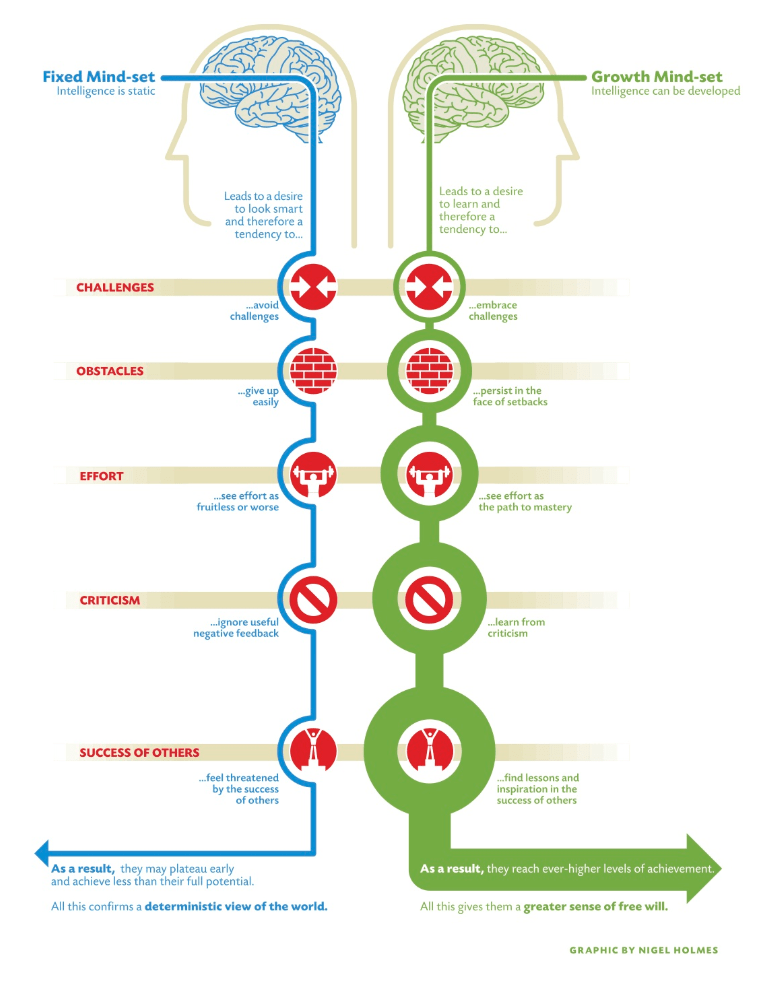
The concept of a growth mindset versus a fixed mindset was introduced by Carol Dweck in 1988. A growth mindset is a belief that an individual’s intelligence and abilities can be grown and developed, whereas a fixed mindset is a belief that intelligence and abilities are static and cannot change (Dweck, 2007). These mindsets affect the way individuals respond to challenges, react to failure and others’ successes, and feel about effort. The graphic below illustrates Dweck’s (1988) research into patterns of behavior aligned with the two mindsets.
How to Develop a Growth Mindset
How can we, as individuals, do the work of minding our mindset? Self-awareness is key to identifying our current mindset and making changes. We must be honest in self-reflection. When we are not truly honest with ourselves when thinking about our mindset, or we don’t fully understand the concept of a growth mindset, it can lead to what Dweck (2015) calls a false growth mindset. This happens when educators or parents “claim to have a growth mindset, but whose words and actions did not reflect it” (Dweck, 2015). Having a growth mindset is a journey and we are not always in one mindset or the other. It’s more of a spectrum.

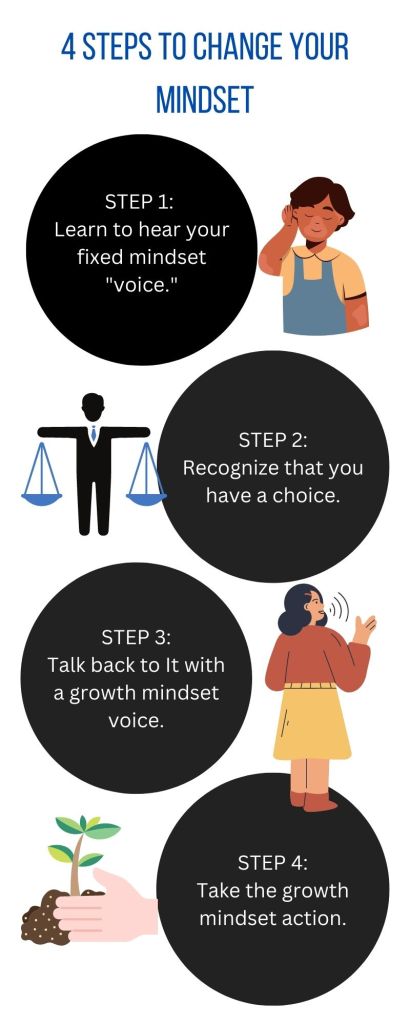
There are four steps outlined by Jeffrey (2020) that can guide a change in mindset:
How Can I Help Others Mind Their Mindset?
Modeling growth mindset behaviors is something each of us can do to mind our own mindset, while also fostering a growth mindset in those around us. As a PL facilitator, I will ensure that the attendees I work with are encouraged to think of their ability to teach foundational reading skills as malleable. As PL attendees practice their teaching skills and are involved in authentic, hands-on learning activities I will provide them with feedback relating to their growth and the effort they are putting into their practice, as well as opportunities to reflect on their learning. These strategies will ensure that PL attendees are learning centered (Moore, 2018).
There are times when some PL attendees are not motivated to learn a new program for a variety of reasons. Fostering a growth mindset can help build that motivation. Beginning a new learning experience with a reminder about the potential to develop intelligence and abilities could be beneficial to boost motivation.
Part of the role of the Certified Facilitator team is to observe teachers implementing RH and provide feedback and support. During job-embedded teacher coaching, there are some questions that can help with orienting toward a growth mindset. These questions are applicable to individuals in many situations. “The more growth-minded questions we ask, the wider, brighter, and larger your world and possibilities become” (Jeffrey, 2020). I will utilize these coaching questions when discussing RH implementation with teachers.
- What can I learn from this?
- What steps can I take to help me succeed?
- Do I know the outcome or goal I’m after?
- What information can I gather? And from where?
- Where can I get constructive feedback?
- If I had a plan to be successful at [blank], what might it look like?
- When will I follow through on my plan?
- Where will I follow through on my plan?
- How will I follow through on my plan?
- What did I learn today?
- What mistake did I make that taught me something?
- Is my current learning strategy working? If not, how can I change it?
- What did I try hard at today?
- What habits must I develop to continue the gains I’ve achieved?
Moving Forward
The power of a growth mindset is evident in the behaviors associated with this belief. A growth mindset allows a person to embrace challenges and effort, desire to learn, and persist through difficulties and setbacks (Jeffrey, 2020). The intention of my plan is to provide a clear path and actionable resources to help myself, my colleagues at RH, and the educators that we work with to move toward embracing a growth mindset and harnessing the power of “yet.”
References
Dweck, C. (1988). A social-cognitive approach to motivation and personality. Psychological Review, 95(2), 256-273. https://www.unco.edu/cebs/psychological-sciences/about-us/faculty-staff/pugh-kevin/dweck_leggett88.pdf
Dweck, C. S. (2007). Mindset: The New Psychology of Success. Random House Publishing Group.
Dweck, C. (2015, September 22). Carol Dweck revisits the ‘growth mindset’ (opinion). Education Week. Retrieved November 1, 2022, from https://www.edweek.org/leadership/opinion-carol-dweck-revisits-the-growth-mindset/2015/09
GCFLearnFree.org. (2021, December 3). Motivation and growth mindset [Video]. Youtube. https://www.youtube.com/watch?v=xTbV6OvNiX8&ab_channel=GCFLearnFree.org
Jeffrey, S. (2020, June 23). Change your fixed mindset into a growth mindset [complete guide]. CE Sage. Retrieved November 5, 2022, from https://scottjeffrey.com/change-your-fixed-mindset/#A_4-Step_Process_to_Change_Your_Mindset
Moore, C. S. (2018, November 7). Five ways to teach students to be learning centered, too. Faculty Focus | Higher Ed Teaching & Learning. Retrieved November 5, 2022, from https://www.facultyfocus.com/articles/teaching-and-learning/five-ways-to-teach-students-to-be-learning-centered-too/
 Facilitation Innovation
4 responses to “Minding the Mindset”
[…] universe to learn more about! Fostering a love of learning can be achieved by striving to be in a growth mindset and helping students to make real-world connections to their learning (Dweck, 2016). This allows […]
LikeLike
[…] Minding the Mindset […]
LikeLike
[…] me as much opportunity for deep learning and growth as I needed. I am working on shifting to a growth and learner’s mindset. I am starting to feel more comfortable with challenges and not knowing the “right” answer. […]
LikeLike
[…] EDLD 5302 Minding the mindset plan […]
LikeLike