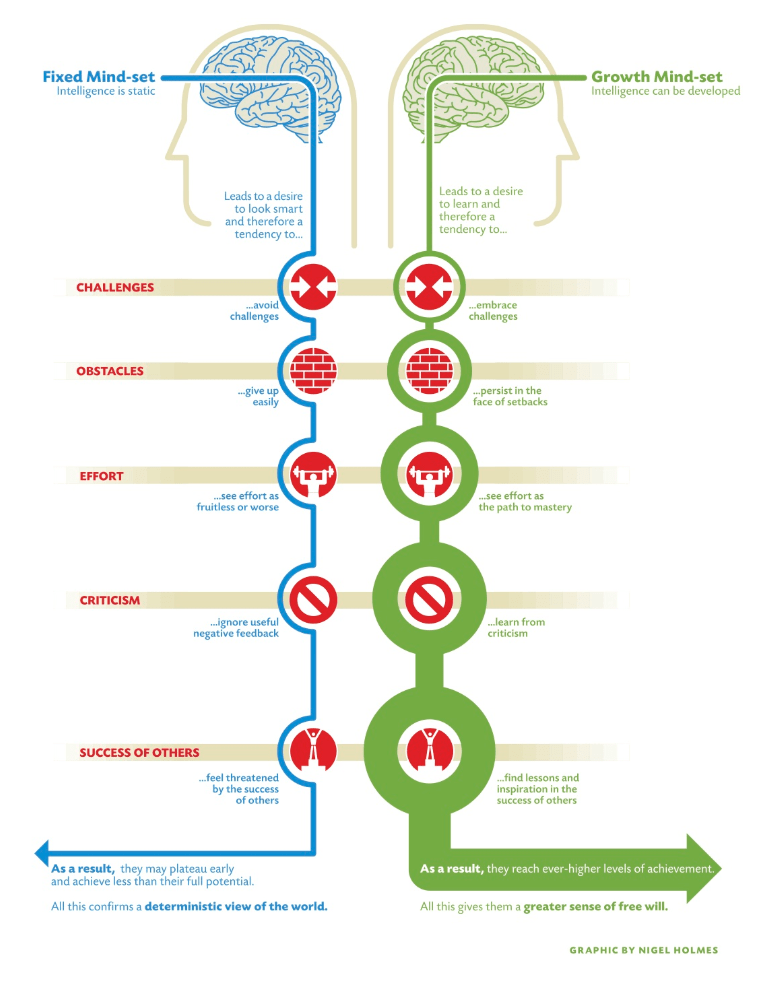
Since beginning the ADL program I have put real effort into honestly analyzing my own mindset. I have seen Carol Dweck’s Growth Mindset video five or six times now. I am making my way through her book as well. The graphic in this post also helps me to understand where I fall on the spectrum of mindset. It is clear to me that I have spent much of my life with a fixed mindset. That has been my default. School always came fairly easily to me and I quickly lost interest in subjects or projects that felt hard or required too much effort. Luckily, this was balanced with my involvement in the arts where effort was required to be successful.
I started learning to play the piano when I was six years old and I have been singing for as long as I can remember. It did not always come easily! I had to put in the effort to develop and grow those abilities. I remember very clearly in fourth grade I desperately wanted to quit piano lessons. My mom said no, and she was my teacher. I fought her pretty hard and eventually the answer was that I had to continue piano lessons until at least sixth grade, then I could quit if I wanted to. My mother also wisely found me a different teacher. These changes helped me to access the motivation to move through the most difficult period of learning to play the piano. By the time I completed sixth grade I had progressed significantly in my piano skills. I chose to continue lessons until eighth grade, then I transitioned to teaching piano to beginning students and focused my efforts on my singing. I developed a true love for music. It is still one of the things I am most grateful to my mom for pushing me through. I also believe it is an experience that helped me to experience a growth mindset.
I spent my educational career chasing grades and taking feedback very personally. Returning to school as an adult I feel that I am in a much more teachable, growth-minded headspace. Dweck (2016) says in Mindset, “even if people have a fixed mindset, they’re not always in that mindset” (p.47). This brings me comfort! I have actually enjoyed receiving feedback and feedforward from my classmates and instructor. I know that even though my grades have not been perfect, it is not a reflection of who I am, what I learned, or what I am capable of. I can learn from my failures and setbacks. Now, if I could only be better about instilling this in my kids! I feel like as a parent it’s incredibly difficult not to focus on my kids’ grades when those grades will literally translate into money for college. Of course, I want them to embrace effort and a true learner’s mindset, but I also have four kids whom I’d like to help further their education in the ways that they choose, and high grades equal scholarship money in our state.
In my professional life, I facilitate professional development and provide coaching for teachers using the curriculum that my company produces. I often provide constructive feedback/feedforward and it is easy to identify the teachers who have a growth mindset. Those coaching sessions are full of positivity, discussion and questions. I call it having a “teachable spirit.” While I feel that in the past the fixed mindset has been my default, I am striving to change my default to a growth mindset.
References
Dweck, C. S. (2016). Mindset: The New Psychology of Success. Ballantine Books.
 Facilitation Innovation
One response to “Growth Mindset Spectrum”
[…] I appreciate the actionable nature of this program. I have learned so much about the importance of cultivating a growth mindset. It is so key to progress that I developed a growth mindset plan to help myself and others within […]
LikeLike